Stainless Steel Rings for Women: Styles & Buying Guide
Stainless steel rings for women: 316L bands, signets, stackable and CZ rings in 18K gold PVD — tarnish-free, nickel-release tested. Sizes, care and wholesale.
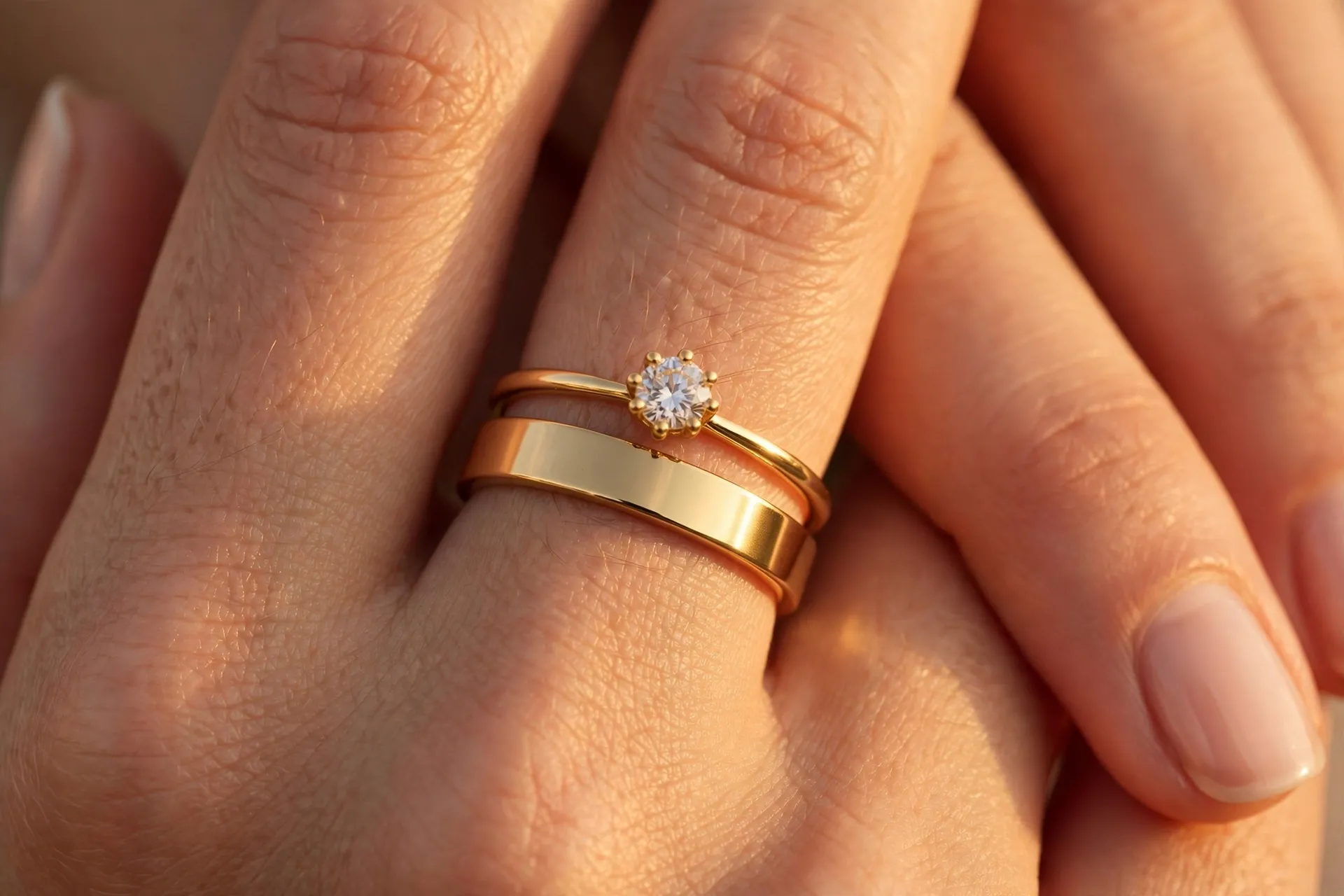
Rings take more wear than any other piece of jewelry: they knock against desks, cups and keys, meet soap and water every time hands are washed, and are looked at all day. That is why the material matters: a plated brass ring loses its colour at the edges within weeks, while a 316L stainless steel ring does not tarnish, keeps its colour through daily wear, and costs far less than the fine jewelry it replaces. This guide covers the styles, sizing and care.
Why 316L stainless steel suits rings
A ring lives on the hand, so it meets water, soap, lotion and sweat constantly. 316L is the grade used in watches and medical instruments: it resists corrosion, holds its shape and does not tarnish, so the band stays bright through shower, sweat and rain in daily wear. Take rings off before a chlorinated pool or the sea, and for heavy lifting.
The colour is 18K gold PVD or silver-colour PVD — a hard, bonded layer, not a thin dip — so it survives the knocks a ring takes every day, and a gold PVD band keeps the look of a gold ring at a fraction of the cost. For more, see our 18K PVD guide.
Our 316L rings are nickel-release tested to EN 1811, so the nickel released is measured and within the EU limit for jewelry in prolonged skin contact. 316L contains nickel, so it is never described as free of nickel.
The styles: bands, signets, stackable and CZ
Plain bands. A polished band, 2–6 mm wide, is the most versatile ring there is: worn alone it is clean and modern, stacked with two or three slim bands it becomes a set. A 2–3 mm band suits a slim finger; a 5–6 mm band reads as a statement. Plain bands are also the easiest ring to gift — no stone to choose, no setting to worry about.
Signet rings. A flat top — round, oval or rectangular — sometimes engraved with an initial or a simple motif. The signet is the ring with the most personality, and engraving makes it a natural personalized gift; see our guide to personalized stainless steel jewelry for engraving and custom options.
Stackable rings. Two or three slim bands worn on one finger, often in mixed textures — one plain, one twisted, one with a row of small stones. Stacking sells rings in sets rather than singly, which matters for a boutique: a customer who buys one stackable ring usually comes back for the second and third.
Cubic zirconia rings. A solitaire or a pavé band set with cubic zirconia gives the look of a diamond ring at a fraction of the cost, and on a 316L band the setting holds its shape without bending. CZ is a hard, bright stone that suits daily wear; it is not a diamond, and it should not be sold as one. For the full comparison, see our guide to stainless steel cubic zirconia rings.
Choosing the right size
Ring size cannot be guessed, and it is the most common reason for a return: too tight will not come off comfortably, too loose will slide off when hands are cold or wet.
Measure at the end of the day. Fingers are slightly larger in the evening and in warm weather, so measure then, on the finger the ring will actually be worn on — fingers differ between hands.
Measure three times. Use a ring sizer or a strip of paper around the finger and repeat three times. If the measurements disagree, take the middle one.
Mind the band width. A wide band fits more snugly than a narrow band in the same size, so moving from a 2 mm band to a 6 mm band usually needs half a size larger. A ring with a stone or a wide top also needs a little more room over the knuckle.
When in doubt, size up. A slightly loose ring can be worn with a small adjuster; a ring that is too tight cannot be worn at all. For a boutique, stocking the middle sizes first and offering the rest to order keeps stock moving without over-ordering.
Styling: one ring or a stack
One ring. A single solitaire, signet or chunky ring on one hand, the other hand bare or with a slim bracelet, is the cleanest look. Keep the finish consistent with the rest of the jewelry — all gold PVD or all silver-colour.
A stack. Two or three slim bands on one finger, or one band on several fingers. Vary one thing at a time — width, texture or stone — and keep the finish the same. A stack works best on the hand without a watch.
How to care for stainless steel rings
Rings meet soap and water every time hands are washed, and that is fine for 316L steel with PVD colour. Wipe with a soft, dry cloth after wearing, clean with mild soap and lukewarm water when needed, and use a soft toothbrush under a stone setting. Put rings on after lotion and perfume, store them separately, and take them off before a chlorinated pool or the sea. With that routine, a 316L ring with 18K gold PVD keeps its colour for years.
Wholesale: stainless steel rings for boutiques and brands
Rings are a December peak category, and stainless steel rings are one of the highest-volume searches in the category. At IVANDA, stainless steel rings for women come in 316L steel with 18K gold, silver-colour and rose gold PVD finishes — plain bands, signets, stackable sets, cubic zirconia solitaires and pavé bands — all nickel-release tested to EN 1811. Browse the range on stainlesstrends.com. MOQ is 60 pieces per style, OEM/ODM and private label are available — we recommend ordering a sample first. For the current range, contact sales at sales01@ivanda-fa.com.
FAQ
Will a stainless steel ring tarnish?
No. 316L steel is tarnish-free and the PVD finish keeps its colour; film from lotion or soap wipes off with a soft cloth.
Can I wear a stainless steel ring every day?
Yes — 316L rings are made for daily wear, through shower, sweat and rain. Take the ring off before a chlorinated pool or the sea.
How do I find my ring size?
Measure the finger at the end of the day, three times, with a ring sizer or a strip of paper. Size up half a size for a wide band.
Is stainless steel good for sensitive skin?
Our 316L rings are nickel-release tested to EN 1811, so the nickel released is measured and within the EU limit. 316L contains nickel, so it is never described as free of nickel.
Is cubic zirconia a diamond?
No. Cubic zirconia is a bright, hard stone that looks like a diamond at a fraction of the cost, but it is a different stone and should not be sold as a diamond.
Can stainless steel rings be resized?
316L steel is hard, so resizing is limited compared with gold or silver. Measure three times, and size up if you are between sizes.