News
316L Stainless Steel Jewelry: The Complete Guide
What is 316L stainless steel jewelry? How it compares with 304, why it stays bright, 18K gold PVD, nickel-release testing and care — wholesale for boutiques.
316L Stainless Steel Jewelry: The Complete Guide
Walk into any jewellery shop today and you will see the same label again and again: 316L stainless steel — on necklaces, earrings, bracelets and rings, in gold, silver-colour and rose gold. What does 316L actually mean, how is it different from 304, and why do so many women — and so many boutiques — choose it? This guide answers all of that, in plain language.
What is 316L stainless steel?
Stainless steel is steel with chromium added, and chromium is what stops it rusting: it forms a thin, invisible layer on the surface that repairs itself when scratched. 316L is an austenitic stainless steel — iron with around 16–18% chromium, 10–14% nickel and 2–3% molybdenum. The "L" stands for low carbon, which makes the steel easier to weld and shape into fine jewellery without weakening it.
The molybdenum is the difference that matters most: it makes 316L far more resistant to chlorides — the salts in sweat, tap water and sea air — than ordinary stainless steel. That is why 316L is the grade used in watches, medical instruments and marine fittings, and for jewellery worn every day, against the skin, in all weathers.
316L vs 304: which is better for jewellery?
304 is the other grade you will see most often: a good steel, hard, bright and rust-resistant, widely used for cutlery and kitchen equipment. But 304 has no molybdenum and less nickel, so it is less resistant to sweat and salt water. Over months of daily wear, a 304 piece is more likely to show faint dulling, especially on earring posts and bracelet clasps that sit in constant contact with skin.
For jewellery, 316L wins in three ways: it resists corrosion from sweat and moisture better, so it keeps its shine longer; it is harder, so chains, rings and clasps hold their shape and resist scratches; and it is the grade nickel-release testing is built around, tested to EN 1811 and within the EU limits for jewellery in prolonged skin contact — which is what makes it suitable for sensitive skin.
That is why IVANDA makes its stainless steel jewellery in 316L. Most of our in-stock pieces are 316L, and custom orders can be made in 304, 316 or 316L to suit the buyer's needs.
Why 316L jewellery does not tarnish
Tarnish is what happens when a metal reacts with air, moisture and sulphur: silver goes dark, brass goes dull, and thin gold plating wears through to a grey base. 316L does not tarnish, because its chromium layer protects the surface and the steel underneath is the same colour all the way through — there is no coating to wear off and no base metal waiting to show through.
That matters for everyday jewellery: a 316L necklace can be worn in the shower, at the gym and in the rain, and still look the same at the end of the day. For the full story on wearing jewellery in water, see our guide to waterproof stainless steel jewelry for women.
18K gold PVD: the finish that makes 316L look like gold
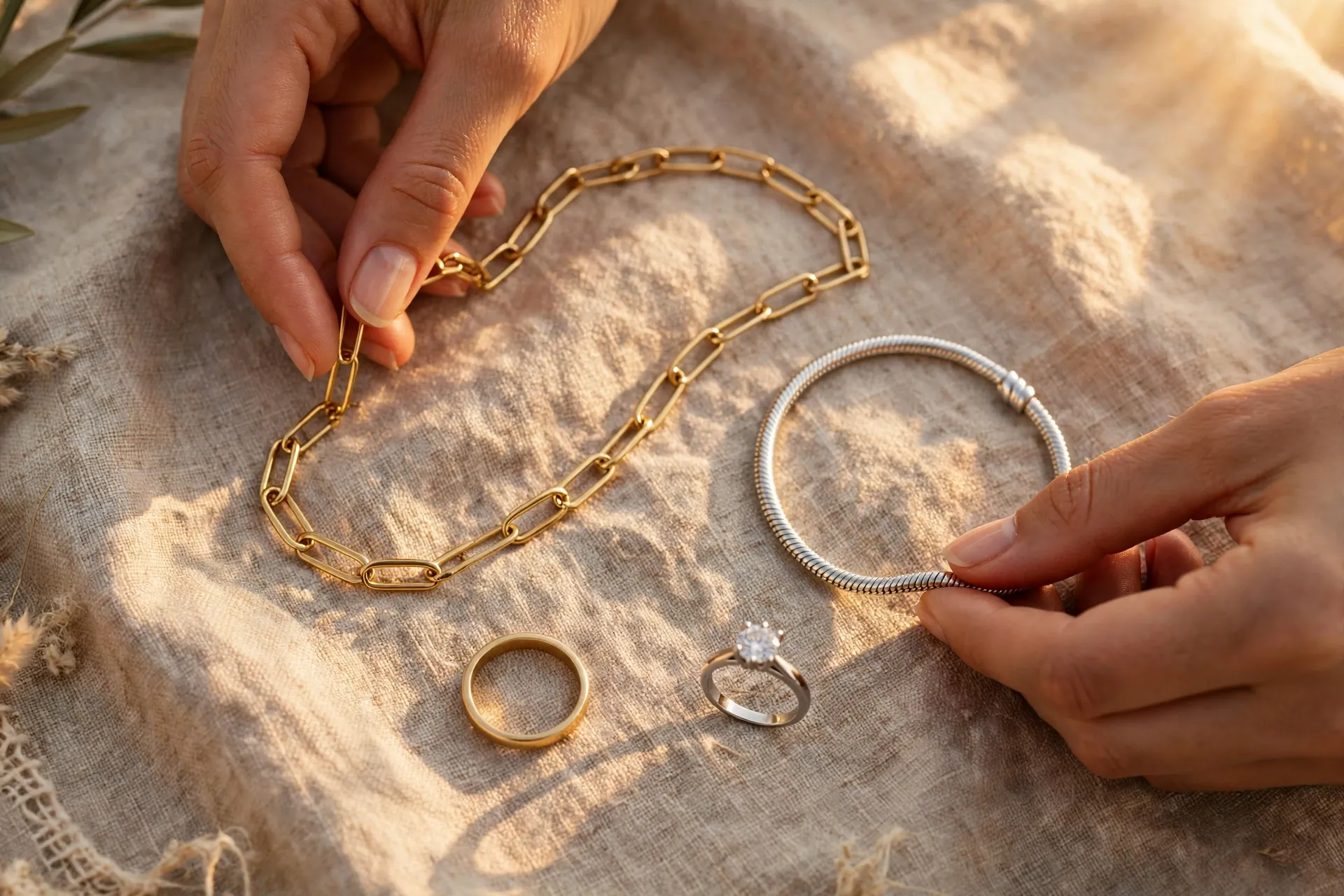
Most 316L jewellery is sold in one of three finishes: 18K gold, silver-colour or rose gold. The gold finish is PVD — physical vapour deposition — a process that bonds a layer of gold-coloured material to the steel in a vacuum chamber. The result is a hard, even layer, usually a micrometre or more thick, far more durable than traditional electroplating.
PVD is why a gold-tone 316L ring still looks gold after a year of daily wear, while a thinly plated brass ring would have worn through at the edges. Silver-colour PVD keeps the natural steel look with a brighter polish; rose gold PVD adds a soft pink warmth. All three sit on the same 316L base, so the care and durability are the same. To learn more about the finish, see our guide to 18K PVD gold plated stainless steel jewelry for women.
Nickel release: what the test actually means
316L contains nickel — around 10–14% — so it is never described as free of nickel. What matters is how much is released onto the skin, and that is what EN 1811 measures. The EU limit under REACH is 0.5 micrograms per square centimetre per week for jewellery in prolonged skin contact, and 0.2 for ear posts. Our 316L jewellery is nickel-release tested to EN 1811 and within those limits, which is why it suits sensitive skin.
If you have sensitive ears or skin that reacts to jewellery, look for that wording — "nickel-release tested to EN 1811" — rather than a vague promise, and ask to see the test report. For more on sensitive skin, see our guide to hypoallergenic stainless steel jewelry for sensitive skin.
How to care for 316L jewellery
316L needs almost no care: wipe each piece with a soft, dry cloth after wearing, clean it when needed with mild soap and lukewarm water, dry it fully before storing, and keep pieces in separate pouches so chains do not tangle and stones do not scratch each other.
Take jewellery off before a chlorinated pool or the sea, and keep perfume, hairspray and sunscreen off the metal — spray first, let it dry, then put your jewellery on. With that routine, 316L jewellery with 18K gold PVD keeps its colour for years.
Wholesale: 316L stainless steel jewelry for boutiques and brands
316L is also a smart buy for boutiques: the grade customers ask for by name, it does not tarnish on the shelf, and it rarely comes back with a complaint. A range in 316L with 18K gold PVD covers everyday wear, gifts and occasion pieces from a single material story. When you buy, check four things: the grade should say 316L; the finish should say 18K gold PVD; the testing should be nickel-release tested to EN 1811, with a report available; and the construction should hold up — a clasp that closes firmly, a soldered chain, and a setting that holds the stone without wobble.
At IVANDA, 316L stainless steel jewelry for women comes in earrings, necklaces, bracelets and rings, in 18K gold, silver-colour and rose gold PVD, with 20,000+ styles and 300+ new designs every month. Browse the range on stainlesstrends.com. MOQ is 60 pieces per style, OEM/ODM and private label are available — we recommend ordering a sample first. Contact sales at sales01@ivanda-fa.com.
FAQ
Is 316L stainless steel jewelry durable?
316L is the grade used in watches and medical instruments: hard, corrosion-resistant and tarnish-free, and with 18K gold PVD it keeps its colour through daily wear. Look for the grade, the PVD finish and a nickel-release test to EN 1811.
Does 316L stainless steel jewelry contain nickel?
Yes, 316L contains around 10–14% nickel. What matters is the release rate: our pieces are nickel-release tested to EN 1811 and within the EU limits.
Will 316L stainless steel jewelry tarnish?
No. Its chromium layer protects the surface and the steel is the same colour all the way through. Wipe it after wearing and keep it off before a chlorinated pool or the sea.