Cubic Zirconia vs Moissanite: Which Sparkles More?
Cubic zirconia vs moissanite sparkle compared: refractive index, fire, how each stone wears over years, and which one suits stainless steel jewelry best.
Moissanite sparkles more on pure physics — a higher refractive index and roughly twice the fire of cubic zirconia — while cubic zirconia delivers the clean, white, diamond-style glint that most everyday jewelry is judged by. Which one is "better" depends entirely on which kind of sparkle you are after, and that distinction matters even more when the stones are set in stainless steel pieces meant for daily wear.
This guide compares the two stones on optics, durability, stainless steel settings and care — then leaves you with a simple rule for choosing.
Sparkle 101: What You Are Actually Comparing
"Sparkle" is really two properties wearing the same name. Brilliance is the white light a stone throws back as light enters, bounces between facets and returns to your eye — driven mainly by the refractive index, which measures how sharply the stone bends light. Fire is the rainbow flash — the same light split into spectral colors as it passes through the stone, measured as dispersion.
Both stones are lab-created. Cubic zirconia (CZ) is zirconium dioxide, produced for jewelry since the 1970s. Moissanite is silicon carbide — a mineral so rare in nature that essentially every moissanite on the market is grown in a laboratory. Neither is mined for jewelry in any practical sense — a fair fight: same origin story, very different physics.
Property | Cubic zirconia (CZ) | Moissanite | Diamond (reference) |
|---|---|---|---|
Refractive index | 2.15–2.18 | 2.65–2.69 | 2.42 |
Dispersion (fire) | ~0.060 | ~0.104 | 0.044 |
Mohs hardness | 8–8.5 | 9.25 | 10 |
Origin | Always lab-created | Essentially all lab-created | Mostly mined |
Moissanite wins both numbers — it bends light more sharply and splits it into more color — and that is the whole technical answer to "which sparkles more."
Which One Actually Looks More Sparkly on the Hand
Numbers aside, here is what the difference looks like in real light. Moissanite returns more white light and flashes harder rainbow fire, so it reads as the more dramatic stone — some people call it lively, others find it almost too flashy in larger sizes. It is also doubly refractive, which gives its facet edges a slightly doubled pattern that adds to the busy, fiery look.
Cubic zirconia sparkles cleanly. Its dispersion is actually higher than diamond's, but its lower refractive index means it returns less raw white light, so the overall effect is a balanced, familiar glint — the pattern people have learned to read as "classic." Held next to a diamond, CZ is usually the stone mistaken for it first.
So the honest answer has two layers. If the question is "which stone flashes more," moissanite wins. If the question is "which stone sparkles the way people expect a diamond to," cubic zirconia is the closer match.
Durability: How Each Stone Ages on the Wrist
Sparkle on day one is easy; sparkle in year three is where the stones separate. On the Mohs scale, CZ sits at 8–8.5 and moissanite at 9.25 — both are hard gem materials, well above glass or crystal. But daily wear does not care about ratings; it cares about what rubs against what.
CZ wears honestly: over years of constant use the surface picks up microscopic scratches, facet edges slowly soften, and those tiny imperfections hold oils and dirt that make the stone look milky. Cleaning restores the dirt-borne dullness, but lost polish is permanent until the stone is repolished or replaced.
Moissanite resists that surface wear far longer. Its polish survives years of wrist-level knocks, and when it does pick up a film of soap or hand cream, a simple cleaning brings back the full sparkle. That is the real gap between the two — not how bright they are new, but how long they stay that way.
Think of CZ as a stone that looks perfect when new and softens gradually, and moissanite as a stone that keeps its factory shine through many years of daily wear.
How the Two Stones Behave in Stainless Steel Jewelry
Stainless steel settings — bezels, prongs and channels cut from 316L steel — treat both stones well, and the differences are more about style than survival:
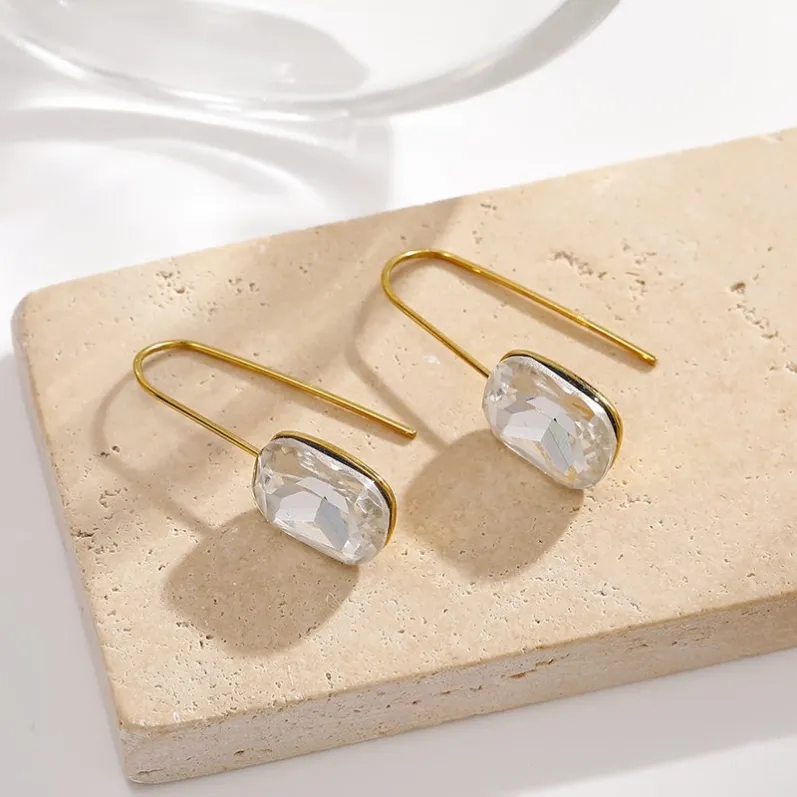
- Color range: CZ is the color workhorse. It is produced in virtually every shade, which is why birthstone-color bracelets and multicolor stone lines are almost always CZ. Moissanite lives mostly in colorless and near-colorless versions, so it suits single statement stones.
- Weight: CZ is noticeably dense — roughly 1.7 times heavier than moissanite by volume — so a CZ-set piece feels solid in the hand.
- Pairing with finishes: colorless moissanite against a PVD 18K gold plated setting is the classic warm-plus-white look, while silver-tone steel with colored CZ reads playful and modern.
One honest note about the finish: PVD bonding is far tougher than old-style dip plating, but it is not immortal. Over years of constant daily wear, the tone gradually softens at the highest-contact points — the underside of a bracelet, the edges of a setting. That is normal for any coated metal, and rotating pieces plus gentle cleaning slows it considerably. Our guide to PVD coating on jewelry explains the process in detail.
For color-heavy fashion pieces, CZ is the only realistic choice of the two; for a single statement stone with maximum flash, moissanite earns its spot.
If you are weighing CZ against crystal rather than moissanite, the comparison changes — our guide to choosing cubic zirconia or crystal covers that decision.
Choosing Between Them: A Practical Rule
You want... | Choose |
|---|---|
Maximum rainbow fire in one statement stone | Moissanite |
The classic, diamond-like white glint | Cubic zirconia |
Many colors in one line — birthstones, multicolor stacks | Cubic zirconia |
A stone that keeps its polish through years of daily wear | Moissanite |
A solid, weighty feel in the hand | Cubic zirconia |
Most lines use both: CZ carries the everyday color-driven designs, while moissanite anchors the occasional hero piece where extra fire justifies the upgrade. Nothing says a catalog must pick a winner.
Treat the two stones as tools for different jobs, not competitors for the same job.
Caring for Either Stone
The routine is identical for both: warm water, a drop of mild soap, a soft toothbrush behind the stone, rinse, and pat dry with a lint-free cloth. Skip abrasive pastes — they scratch CZ and the steel around it — and skip chlorine soaks, hard on every finish and setting. Rinse after swimming or heavy sweating, store pieces separately so stones cannot scratch each other, and put jewelry on after perfume and lotion.
If a CZ piece still looks cloudy after a proper cleaning, the cause is surface wear on the stone itself, not dirt — no cleaning product reverses that.
Regular gentle cleaning keeps both stones at their best; the difference is only that moissanite's ceiling stays higher for longer.
Frequently Asked Questions
Quick answers to the questions buyers ask most when comparing these two stones.
Which sparkles more, moissanite or cubic zirconia?
Moissanite sparkles more on raw optics: its refractive index of 2.65 beats CZ's 2.15, and its dispersion of about 0.104 is roughly double CZ's 0.060, so it returns more white light and flashes more rainbow fire. CZ produces a cleaner, more diamond-like sparkle. Choose moissanite for maximum flash and CZ for the familiar classic glint.
Does cubic zirconia lose its sparkle over time?
Gradually, yes. Years of daily wear put microscopic scratches on the surface and soften facet edges, and those imperfections trap oils that make the stone look milky. Cleaning removes the film but not the wear. On a bracelet worn occasionally and cleaned regularly, CZ stays bright for a long time before the change becomes noticeable.
Is moissanite a diamond?
No. Diamond is crystalline carbon; moissanite is silicon carbide, and nearly all commercial moissanite is lab-grown because natural crystals are vanishingly rare. It is a distinct gemstone with its own optical signature — stronger fire and double refraction — which is exactly why it is called a diamond alternative rather than a diamond.
Can you tell CZ and moissanite apart by eye?
Usually yes, side by side. Moissanite shows noticeably stronger rainbow flashes, and its double refraction can make facet junctions look slightly doubled. CZ reads as a cleaner white sparkle. In small accent sizes the difference is subtle; in larger solitaires it is obvious even to non-experts.
Which stone is better for stainless steel jewelry?
CZ, for most pieces: it is produced in every color, it suits birthstone and multicolor designs, and it keeps a whole line consistent stone to stone. Moissanite suits single-statement solitaires where extra fire is the point. Both are hard, lab-created stones that pair safely with 316L steel and handle daily wear far better than glass.
Wholesale Stainless Steel Jewelry from IVANDA
Looking for a reliable stainless steel jewelry supplier? IVANDA supplies 316L pieces with PVD 18K gold plating - waterproof, skin-friendly and made for everyday wear. MOQ 60 pcs per style, in stock and ready to ship, with OEM/ODM services for custom designs. Message us on WhatsApp or email sales01@ivanda-fa.com for the latest catalog and wholesale prices.