Oct 26, 2026
How to Match Jewelry with Office Dress Codes
Match jewelry to any office dress code: what to wear for business formal, business casual and creative offices, with materials that survive long days.
The most professional jewelry in any office is rarely the most noticed — it is the piece chosen to fit the room, so colleagues remember that you looked polished rather than trying to recall what sparkled.
Jewelry is the fastest tool for looking intentional at work: one well-chosen piece turns a plain shirt into a decision instead of a default. But a piece that looks right in a creative studio can look careless in a law firm, and the rules are almost never written down. This guide decodes the four common dress codes, matches jewelry to each, and adds the practical tests that matter more than any written policy.
First, Decode the Dress Code
Most workplaces fall into one of four levels, even when nobody names them. Before consulting any rulebook, look at what the most respected people in the office wear — that is the real dress code.
Dress code | Typical outfit | Jewelry volume that fits |
|---|---|---|
Business formal | Suits, tailored dresses, closed shoes | Minimal, small, one metal story |
Business casual | Blazers, knitwear, smart trousers | Medium, one or two focal pieces |
Smart casual | Structured denim, relaxed tailoring | Freer, layers and texture welcome |
Creative office | Self-expression is part of the job | Statements and bigger pieces allowed |
Treat dress codes as volume control, not a ban — every level allows jewelry; the levels differ only in how much attention each piece should draw.
Business Formal: Quiet, Precise, Minimal
Formal environments reward precision: the classic approach is two to three small pieces in one finish, chosen so they never compete with the outfit's clean lines:
- Stud earrings in a classic size — nothing that swings when you turn your head
- A single fine chain that sits at or just above the collar line
- A watch, which counts as jewelry and reads as timekeeping
- One or two slim rings
What to avoid is just as specific: anything that jingles, catches light with every gesture, or enters the room before you do. The outfit should read as one composed unit, with jewelry as punctuation, not a paragraph.
In formal settings, precision beats quantity — two or three small pieces in a single finish read as deliberate, while a fuller stack reads as distraction.
Business Casual: Where Personality Starts to Show
Business casual is the sweet spot for most jewelry lovers — relaxed enough for layering and one focal piece, yet still calling for restraint. What works:
- Layered necklaces at staggered lengths — the collarbone zone is prime real estate, and our necklace chain length guide maps which lengths pair with which necklines
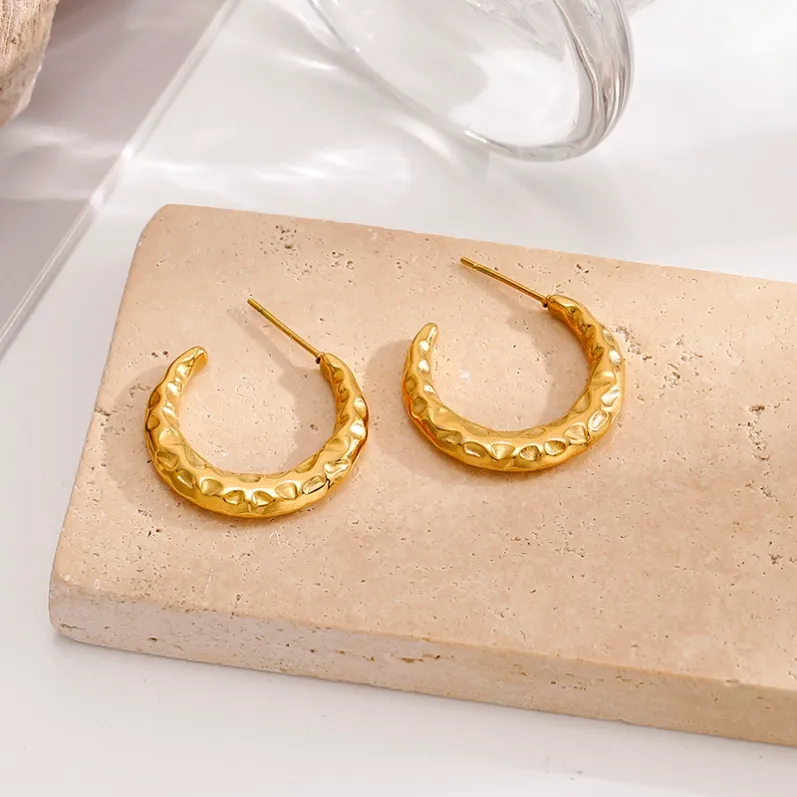
- Small hoops or huggies, which read as polished without the swing of large hoops
- One statement piece per outfit — a chunky chain or a sculptural ring, never both at once
Many professionals land on a two-part formula: a quiet daily base (studs, a fine chain, a watch) plus one rotating focal piece that changes with the outfit — one less decision on a busy morning.
Business casual offers the best ratio of freedom to professionalism — keep a quiet daily base and add one focal piece that changes with the outfit.
Creative Offices: Bigger Is Allowed, Chaos Is Not
In creative environments, jewelry is part of the portfolio — it signals taste before a single word is exchanged. But the people who carry statement jewelry well follow one invisible rule: commit to a system instead of accumulating separate loud pieces.
- An ear stack built over years, all in one finish, reads as identity; six unrelated pieces read as noise
- Mixed finishes work when intentional — matched weights or a repeated texture
- One signature element repeated daily — a specific ring, a chain style — builds recognition
Creative dress codes reward a personal signature more than sheer quantity — a repeating element, like a consistent finish or a signature ring, reads as style; unrelated loud pieces read as clutter.
The Four Tests Every Office Piece Must Pass
Before any piece earns a place in the work rotation, run four quick tests:
- The noise test. Shake your hand, turn your head, lean toward someone — bangles that clink and long charms that rattle become background noise for everyone within earshot.
- The desk test. Sit down and type for ten minutes: bracelets that clack on the desk edge and necklaces that swing into the keyboard will annoy you by mid-morning.
- The comfort test. Wear the piece a full day: heavy earrings pull by afternoon, sharp ring edges catch on everything, and anything needing constant adjustment does not belong at work.
- The camera test. Look at yourself on a video call — earrings and the front of a necklace are what read on screen; almost everything else disappears.
If a piece passes the noise, desk, comfort and camera tests, it will pass any dress code — those four tests matter more than written rules.
Materials That Survive Office Life
Office jewelry lives a harder life than it appears: bag straps and coat zippers abrade chains on the commute, handwashing and sanitizer attack rings dozens of times a day, and long days keep pieces on through lunch, gym sessions and evening plans.
That reality is why 316L stainless steel has become the default for weekday jewelry: it resists the scratches that softer metals collect from bags and keyboards, tolerates water and sweat without discoloring, and PVD 18K gold plated steel keeps its warm color through years of exactly this treatment. For all-day wearability — especially for ears that have reacted to other earrings before — smooth steel posts make a noticeable difference, as covered in our guide to earrings for sensitive ears. And because workdays spill into dinners and workouts, water-friendly steel means one set covers the whole day; our guide to what waterproof jewelry really is explains how these pieces handle all of it.
Workday jewelry needs stamina more than sparkle — 316L steel and PVD 18K gold plated finishes survive the bags, commutes and long hours that wear out softer pieces.
Earrings on Camera: The New Front Line
Since so many meetings now happen on video, earrings have quietly become the most visible jewelry in professional life: the camera frames the face, the earlobes sit exactly in frame, and the rest of the outfit barely appears.
- Studs and small hoops read clean and deliberate on camera
- Long drops get cropped by the frame or swing distractingly between frames
- Very sparkly stones flicker under webcam compression; softly polished finishes read better than mirror shine
The practical fix is a dedicated pair of "camera studs" — a classic size in a finish that suits you, kept by the desk. The video-call question is then permanently solved.
On camera, earrings carry nearly the whole message — clean studs or small hoops do more for a video meeting than any necklace.
Frequently Asked Questions
How much jewelry is too much for the office?
A dependable rule is one focal point per outfit. If the necklace is the statement, keep earrings and rings quiet; if the earrings are bold, let the neckline stay bare. Watches and wedding rings already count toward the total, so build around those fixed pieces. When unsure, remove one before leaving the house.
Are hoop earrings professional?
Small and medium hoops absolutely are. Huggies and slim hoops read as polished in almost any office, while very large hoops draw attention and swing, which reads less formal. The professional hoop keeps a slim profile, stays still when you move your head, and matches the finish of the rest of your jewelry.
What earrings work with a formal suit?
Classic studs in a moderate size are the safest match for structured tailoring, because the suit's lines are the statement. Small ball or bezel-set studs add polish without competing. If you want something more visible, a short drop with minimal movement works — the key is that nothing swings when you turn your head during a meeting.
What jewelry looks best on video calls?
Earrings first, because the camera frames your face — clean studs or small hoops in a flattering finish. A necklace works only if it sits above the frame line, so shorter chains outperform long pendants. Avoid anything highly reflective, since webcam compression makes mirror-shine surfaces flicker distractingly.
One focal point per outfit, plus the four practical tests, resolves most office jewelry questions before the mirror does.
Wholesale Stainless Steel Jewelry from IVANDA
Looking for a reliable stainless steel jewelry supplier? IVANDA supplies 316L pieces with PVD 18K gold plating - waterproof, skin-friendly and made for everyday wear. MOQ 60 pcs per style, in stock and ready to ship, with OEM/ODM services for custom designs. Message us on WhatsApp or email sales01@ivanda-fa.com for the latest catalog and wholesale prices.