Oct 23, 2026
The Best Stainless Steel Jewelry for Layering
The best layering jewelry in stainless steel — thin necklaces, stackable bracelets and rings that survive friction, water and daily wear with a clean look.
The best layering jewelry shares three traits: it is slim enough to stack without bulk, tough enough to survive constant contact with other pieces, and consistent enough in finish that the whole stack reads as one deliberate look. Stainless steel nails all three — which is why so many stylists build their layered looks on a steel base and add accent pieces on top.
This guide breaks down which chains, bracelets and rings layer best, how to combine them, and why steel outperforms softer metals once pieces touch all day.
What Makes Jewelry Good for Layering?
Takeaway: good layering pieces are low-friction, low-bulk and tonally consistent — everything beyond that is personal taste.
When pieces stack, they rub and overlap for hours, which kills fragile finishes and tangles chunky designs. Before buying anything for a layered look, run it through this checklist:
Layering criterion | What to look for | Why it matters |
|---|---|---|
Profile | Flat, slim chains and slim bangles | Bulky pieces gap the stack and snag hair |
Durability | Hard, scratch-resistant material | Layered pieces constantly touch |
Tarnish behavior | Material that will not rust or mark skin from sweat | Stacked pieces trap moisture against skin |
Finish consistency | Similar polish level across the stack | Mixed finishes read accidental, not styled |
Weight | Light to midweight | Heavy stacks pull at the neck and tire the wrist |
That last row matters: three or four pieces together can triple the weight pressing on one spot of your neck or wrist.
The Best Stainless Steel Necklaces for Layering
Takeaway: build stacks on flat chains in graduated lengths — one anchor chain, one mid chain, one statement piece — each sitting a few centimeters apart.
Chain style decides how a necklace lies, how it tangles and what role it plays in the stack:
Chain style | Profile | Layering role |
|---|---|---|
Cable | Simple uniform links, lies flat | The workhorse anchor at any length |
Curb | Flattened, interlocked links | Sleek mid layer; slightly wider reads dressier |
Box | Square links forming a smooth ribbon | Clean, minimal mid layer |
Figaro | A pattern of long and short links | Adds rhythm without bulk |
Rope | Twisted links that catch the light | Statement finisher on the longest length |
Paperclip | Elongated flat links | Modern line; carries a pendant well |
The classic formula: a 16 in chain up top, an 18 in at the collarbone, and a 20–24 in pendant or rope chain to finish. Keep each layer a few centimeters apart so chains do not rub in one spot all day. One pendant per stack is usually enough — two competing pendants read noisy. For full spacing technique and anti-tangle tricks, see our no-tangle guide to layering necklaces.
The Best Stainless Steel Bracelets for Stacking
Takeaway: mix textures, not widths — two or three slim pieces in different link styles beat five identical chains squeezed together.
Bracelet style | Stacking behavior | Pairs well with |
|---|---|---|
Curb chain bracelet | Lies flat and hugs the wrist | Bangles and cuffs worn beside it |
Bangle | Rigid circle that keeps its shape | Separates and spaces soft chains |
Cuff | Wide, one clear statement spot | Slim chains on either side |
Beaded | Adds texture and depth | Flat chains and cuffs |
Slim link bracelet | Quiet filler between louder pieces | Everything — the stack's glue |
A reliable wrist stack: one flat curb chain as the base, one bangle for structure, and one cuff or beaded piece as the accent. Space them so nothing digs in during daily movement. For spacing order and fit rules, our wrist stacking guide covers the full method.
Stackable Rings That Work Together
Takeaway: keep band widths similar and stack in odd numbers — three or five — with one textured ring as the focal point.
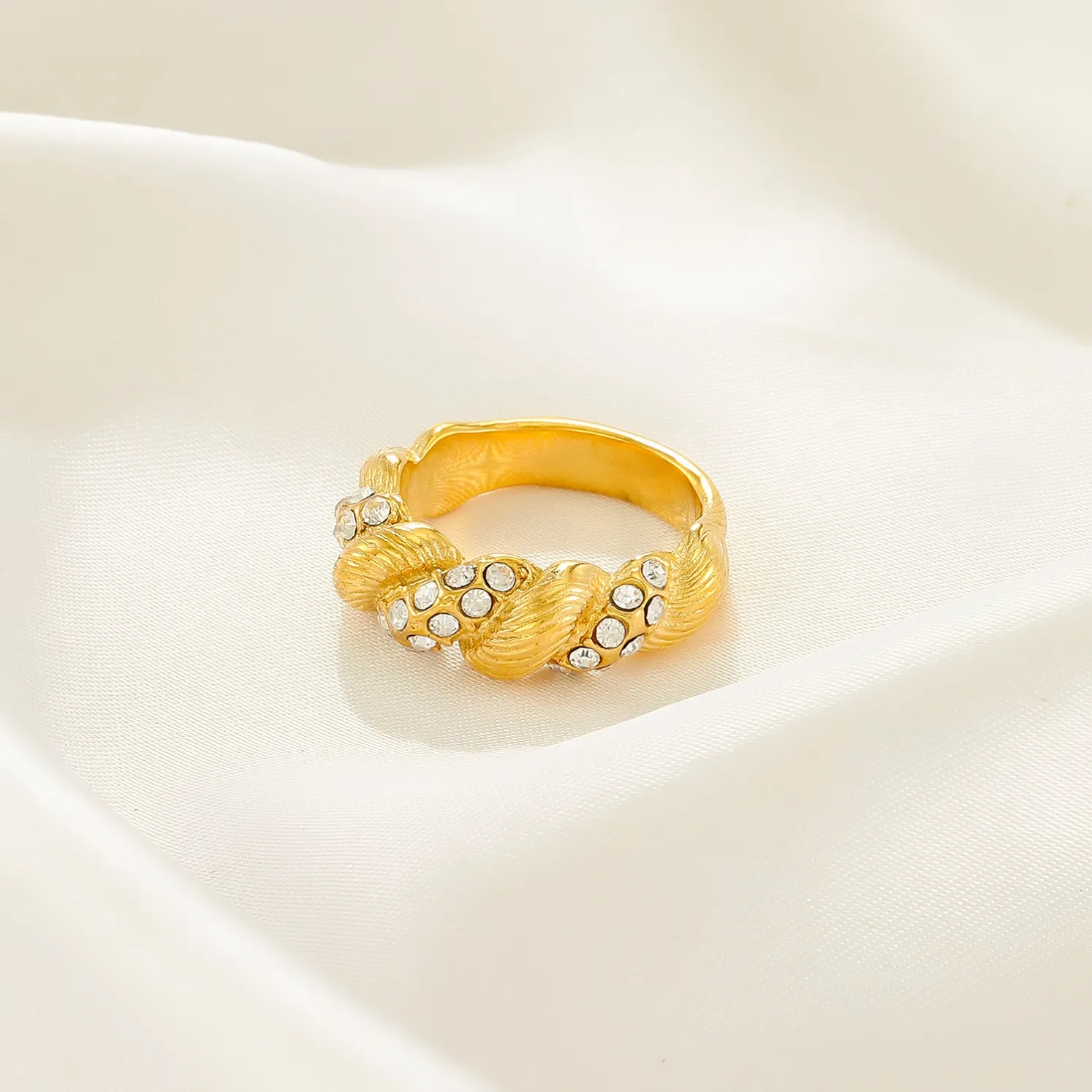
Stacking rings are the most forgiving category: slim 1–2 mm bands in mixed finishes create the look with minimal effort. Stainless steel bands hold their polish even where they press together through the day — exactly where softer plated metals chip first. Keep one wider or textured ring as the anchor and fill around it with plain bands; if one piece is PVD 18K gold plated, let it be the accent so the contrast looks intentional.
Why Stainless Steel Wins for Layered Looks
Takeaway: layered pieces live in constant contact — with each other, with water, with sweat — and stainless steel is built for exactly that abuse.
Layering multiplies every weakness a material has — more contact points mean more friction and trapped moisture. That is where 316L stainless steel separates itself from brass, plated alloy and soft silver pieces:
- Water and sweat resistance — it will not rust or leave marks when stacked pieces trap moisture against the skin
- Scratch resistance — steel pieces rubbing together dull far slower than soft plated alloys
- Finish stability — one consistent polish or PVD 18K gold plated tone across the stack keeps the whole look cohesive
An honest limitation: PVD plating bonds far more strongly than classic plating, yet no plating is immortal. Years of stacked friction — a hard edge grinding on one link daily — will gradually soften the tone. Rotate stacks and wipe pieces after salty or chlorinated water, and the finish lasts noticeably longer.
Building a Layering Capsule That Sells
Takeaway: for brands, layering is a merchandising strategy — sell lengths and widths as sets, not as single pieces.
Layering is one of the easiest looks for a brand to merchandise because it multiplies units per customer. Stock chains in three graduated lengths, bracelets in one flat plus one rigid style, and slim bands in two finishes — then market them as ready-made stacks. Describing how pieces sit together turns a plain product page into a styling lesson; our guide to writing jewelry product descriptions shows the structure.
Frequently Asked Questions
Quick answers to the layering questions we hear most.
How many necklaces is too many in one stack?
Three is the sweet spot for most necklines; four works with very plain tops. Beyond that, stacks tangle easily, add weight and swallow the neckline. Want more presence? Upgrade one layer to a wider chain or add a single pendant instead of a fourth chain — one change reads better than one more line of metal.
What lengths should I choose for layering necklaces?
Start at 16 in and step up in increments of about 4–6 cm so each chain sits visibly apart. A 16–18–20 in trio is the classic formula; add a 24 in pendant for depth under deeper necklines. Match the longest length to your torso — petite frames usually top out near 20 in, taller frames carry 24 in easily.
Will layered bracelets scratch each other?
Any metal-on-metal contact produces micro-scratches over time; the question is how fast they show. Stainless steel is hard enough that stacked pieces keep their polish far longer than soft plated alloys, which chip quickly. Flat chains also fare better than sharp bangle edges — and store pieces separated between wears.
Does PVD 18K gold plating wear faster when jewelry is layered?
It can, because layering doubles the friction a finish endures. PVD plating bonds far more strongly than classic electroplating, so a PVD 18K gold plated piece handles stacking much better than older plating methods. Still, avoid a rough edge grinding daily on one link, and remove stacks before gym sessions with grip equipment.
Can I mix steel with other metals in one stack?
Yes, if profiles are compatible and tones deliberate. Stainless steel's clean polish — steel or PVD 18K gold plated — bridges well because it neither yellows its neighbors nor stains them. Avoid stacking steel against soft plated costume jewelry: the softer finish loses that contest quickly, and wear shows within weeks.
Wholesale Stainless Steel Jewelry from IVANDA
Looking for a reliable stainless steel jewelry supplier? IVANDA supplies 316L pieces with PVD 18K gold plating - waterproof, skin-friendly and made for everyday wear. MOQ 60 pcs per style, in stock and ready to ship, with OEM/ODM services for custom designs. Message us on WhatsApp or email sales01@ivanda-fa.com for the latest catalog and wholesale prices.