Nickel Release Test: Stainless Steel Jewelry | IVANDA
Nickel release testing decides whether stainless steel jewelry can be sold in the EU and what US buyers need. Learn what the test is and what to ask for.
Short answer: A nickel release test measures how much nickel migrates from a finished piece of jewelry during prolonged contact with the skin. In the EU, that measurement decides whether the piece can be sold: nickel release from articles in prolonged skin contact is restricted under REACH, and the recognised test method is EN 1811. In the United States there is no federal nickel-release limit for jewelry, but brands selling in California still need to think about Proposition 65, and retailers everywhere increasingly ask for test data before they list a product. As a buyer, the rule is simple: ask for the test report for the exact SKU and finish you are ordering, check that the method, the samples, and the result are all stated, and confirm that bulk production matches the tested samples. A report you can file is a product you can sell.
Why Nickel Release Is the First Compliance Question
Nickel is the reason this test exists, and it is also the reason buyers sometimes misunderstand it. Nickel is an ordinary part of 316L stainless steel — the grade contains nickel 10–14%, alongside chromium 16–18%, molybdenum 2–3%, and carbon at a maximum of 0.03%. Nickel is also one of the most common causes of contact allergy, which is why regulators in Europe restrict how much of it can be released from jewelry worn against the skin. The important distinction is between nickel content and nickel release. Content is how much nickel is in the metal; release is how much of it migrates out during wear. The regulation controls release, not content, because release is what touches the skin. A piece can contain nickel and still comply, provided the amount released stays within the applicable limit — and that is exactly what the test measures.
That distinction shapes the whole buying conversation. A supplier that tells you the steel is 316L has told you about the material, not about the finished piece. The finished piece includes the PVD coating — IVANDA uses 18K PVD gold — and the coating is a barrier between the steel and the skin, so its quality and consistency affect the release result. Assembly matters too: a soldered joint, a plated clasp, or a component from a different material can behave differently from the main body of the piece. The test is run on the finished article for that reason. When a buyer asks for a nickel release report, the buyer is asking the only question that actually answers whether the product can be sold in the EU.
What the Test Is and How It Works
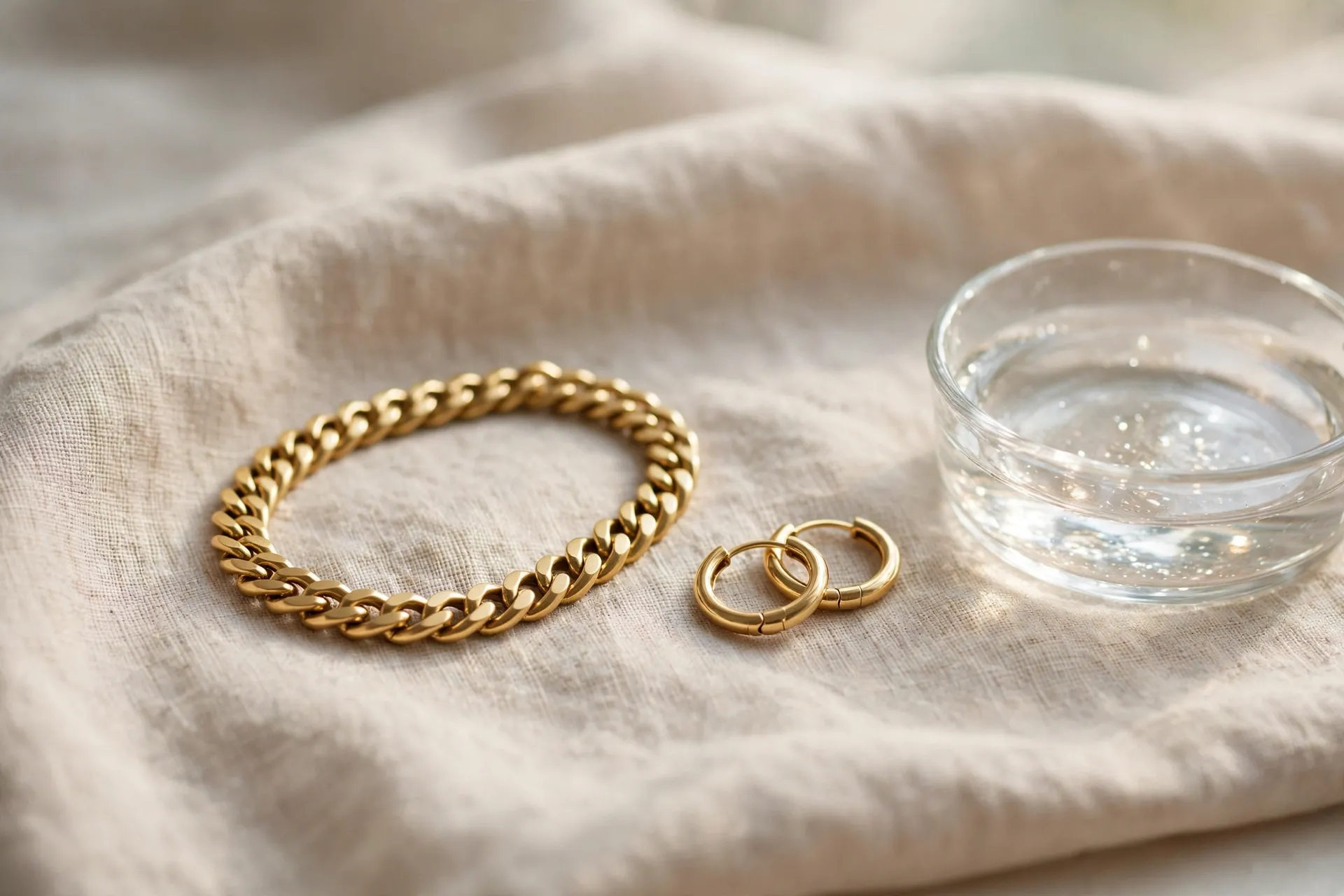
The recognised method in Europe is EN 1811, the standard test for nickel release from articles in direct and prolonged skin contact. In the test, the finished article is immersed in an artificial sweat solution for a defined period under controlled conditions, and the amount of nickel released into the solution is measured and reported. The result is expressed as a release rate for the tested article, and it is compared with the applicable limit in the regulation.
For a buyer, the mechanics matter less than the discipline around them. The test must be run on the finished piece in the finish you are ordering — not on raw steel, not on an uncoated blank, and not on a different colour. Different PVD colours can behave differently, so a report for a gold finish does not cover a rose-gold finish. The report should state the laboratory, the method, the samples tested, and the result. If any of those is missing, the report is incomplete, and you should ask for the missing piece before you order.
The test also has limits a buyer should understand. It measures nickel release under laboratory conditions that simulate wear; it does not predict how an individual wearer will react, and it does not certify that a piece is suitable for every wearer. Some people react to very low levels of nickel, and no test result changes that. So describe the product honestly in your own marketing: a tested, compliant piece is a well-made product with evidence behind it, not a product that can never cause a reaction in anyone. The honest wording protects your brand and keeps your retail customers' expectations realistic.
EU and USA: Two Different Rulebooks
The EU and the US handle nickel release differently, and a buyer selling into both markets needs to know which rulebook applies where.
The EU: a limit, a method, and a report
In the EU, nickel release from jewelry in prolonged skin contact is restricted under Annex XVII of REACH, and EN 1811 is the recognised method for demonstrating compliance. The practical consequence is clear: if you sell in the EU, you need a test report for the finished pieces you are selling, and the report must show a result within the applicable limit. The limit itself is set in the regulation — confirm the exact value in the test report for your specific SKU rather than relying on a general statement — and your supplier should be able to tell you which limit the laboratory applied. Retailers, marketplaces, and market-surveillance authorities in the EU all work from the same expectation, so the documentation you collect for Germany works for France and the rest of the EU as well. For the wider REACH picture, including the Candidate List and the compliance statement to request, read the companion guide on REACH compliance for stainless steel jewelry, and the EU buyers' nickel checklist.
The USA: no federal limit, but do not ignore it
In the United States there is no federal nickel-release limit for jewelry comparable to the EU restriction. That does not mean the question disappears. California's Proposition 65 lists nickel, and brands selling in California need to consider warning and labelling requirements — confirm the current position with your own legal adviser for the specific product and channel, because the requirements depend on how and where the product is sold. Beyond California, US retailers still ask for test data: a buyer who can produce an EN 1811 report for a product has an answer ready for any retailer who asks, in any market. The sensible approach for a brand selling in both regions is to hold the product to the stricter standard and keep the same documentation for every market. One standard, one file, no surprises at the border or at the listing desk.
How to Ask for the Report — and Check It
Ask at the quotation stage, before any deposit is paid, and ask for the report for the exact SKU and finish on your order. A complete request has four parts. One, the test report itself, stating the laboratory, the EN 1811 method, the samples tested, and the result. Two, confirmation that the samples were finished pieces in the finish you are ordering. Three, the date of the report, so you can confirm it reflects the current material and coating process rather than an older setup. Four, written confirmation that bulk production will use the same 316L material and the same 18K PVD coating process as the tested samples.
When the report arrives, read it. Check that the product description matches your SKU, that the finish matches, and that the result is stated in full rather than summarised as a single word. File it with the order, by SKU, so the document and the product are never separated. Keep a copy ready for your retail customers, because the same question you asked your supplier is the question your customers will ask you — and the buyer who answers fastest is the buyer who gets listed.
Red flags to watch for
A report with no laboratory name, no date, or no sample description should not be accepted as evidence. A report for a different design or a different PVD colour does not cover your SKU. A general statement that "all our products pass" is not a report. And a supplier that only produces the report after the deposit is paid has removed your ability to act on it. If no report exists for your SKU, ask whether testing can be arranged and what it would cost in time before bulk production. If no testing can be arranged at all, weigh that gap against the size of the order, consider ordering samples first, or choose a design that already has test evidence. For the wider documentation picture, see the stainless steel jewelry certifications guide, and for shipment checks, the quality control guide.
Your Next Step: Test Evidence Before Bulk
Make the nickel release report a standard line on your order checklist, alongside the material grade, the coating specification, and the salt spray test report. Request it at the quotation stage. Check the method, the samples, the finish, the date, and the result. Confirm that bulk production matches the tested samples. Then order samples — the report describes laboratory conditions, and the samples show you the colour, weight, clasp, and finish of the piece your customers will actually wear. Both checks answer different questions, and a careful buyer wants both.
If you are sourcing 316L stainless steel jewelry with an 18K PVD gold finish for the EU or US market, start with samples and test evidence together. IVANDA has manufactured stainless steel jewelry since 2016 from a 3,500 square metre factory in Yiwu, with a monthly capacity of 300,000 pieces, supplying retailers and brands on a 60-piece-per-style minimum with custom production in 25–35 days. Ask for the nickel release test report for the SKUs you are considering, review it against the checklist above, and order samples before you commit to bulk.
Get a Quote or Request Samples: send your designs or a shortlist from the catalogue to IVANDA through the OEM / ODM page or the contact page. Include the SKU, the PVD colour, the quantity per style, and the markets you are selling into — and ask for the nickel release test report with the quotation, not after it.
Frequently asked questions
Does 316L stainless steel contain nickel?
Yes. 316L contains nickel 10–14%. What REACH restricts is nickel release from the finished piece during prolonged skin contact, not the nickel content of the steel. Compliance is demonstrated by testing the finished article, normally to EN 1811.
Is a nickel release test required in the USA?
There is no federal nickel-release limit for jewelry in the US. However, California's Proposition 65 lists nickel, and US retailers commonly ask for test data anyway. Brands selling in both the EU and the US usually hold their products to the EU standard and keep the same documentation for every market.
Can one report cover all my designs and colours?
No. A report covers the samples that were tested. Different designs and different PVD colours need their own evidence. Ask for the reports that match the SKUs and finishes you are actually ordering.
What should I do if the supplier has no test report for my SKU?
Ask whether testing can be arranged and how long it would take before bulk production. If no report can be provided, consider ordering samples first or choosing a design that already has test evidence. Do not place a bulk EU order without documentation you can show your own customers.